
I DON'T JUST SOLVE PROBLEMS.
I DESIGN SYSTEMS THAT PRODUCE BETTER OUTCOMES.

Economics | AI | Technology | Investment
Entrepreneurship | Leadership | Human Development
AI BUSINESS & INNOVATION STRATEGIST • ENTREPRENEUR • ECONOMIST • SYSTEMS THINKER
I DON'T JUST SOLVE PROBLEMS.
I DESIGN SYSTEMS THAT PRODUCE BETTER OUTCOMES.
Economics | AI | Technology | Investment
Entrepreneurship | Leadership | Human Development

A Practical Framework for Leadership-Purpose, Mind Transformation, Systemic Justice and Safety.
3.5
3767 Views

Addressing ethical capitalism, innovation ecosystems, and generational wealth architecture in developing societies.
3.5
3767 Views

The future of civilization depends on producing humans capable of acting as regenerative citizen-leaders.
3.5
3767 Views

Credible individuals with character, competence, and compassion to occupy elective and appointive positions
3.5
3767 Views

Secret of Human Unity and Supernatural Exploits for Believers
3.5
3767 Views

How to be Safe Against Invisible Evil Forces. Do not Live By Chance or Good Intentions.
3.5
3767 Views


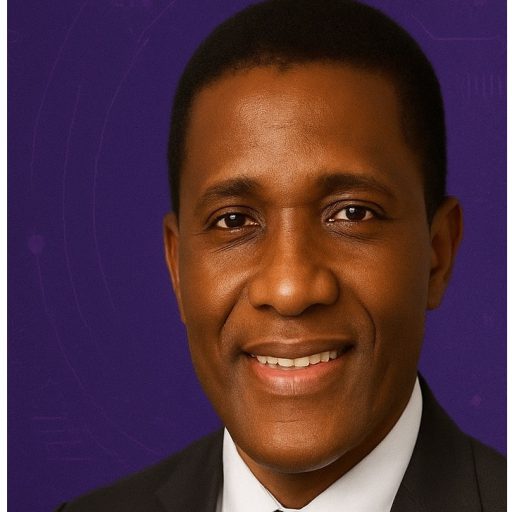
I Don’t Just Solve Problems. I Design Systems That Produce Better Outcomes.
My work sits at the intersection of economics, entrepreneurship, technology, artificial intelligence, investment, leadership and human development.
I am particularly interested in one question:
How can we design better systems for people, organizations and societies to create sustainable value and transformation?
Through my frameworks, policy designs, and institutional initiatives, I advance structural approaches to life, leadership, governance and success —prioritizing principled based systems, time mastery, human capacity optimization, ethical power alignment, and economic resilience.

I deploy principles and systems for predictable results and sustainability.

I believe in transparency and ethics in delivering quality and achieving set gaols.
Testimonials


Frequently Asked Questions
Below are selected questions and insights addressing key areas of governance reform, institutional architecture, and strategic transformation. If your inquiry is not addressed here, you are welcome to reach out directly via the contact form or provided executive contact details. All communications are handled with professionalism and discretion.
Reacting without redesigning. Crisis often reveals structural weaknesses — fiscal fragility, weak regulatory systems, poor institutional memory. Yet many leaders respond with emergency measures instead of structural correction. Crisis often reveals structural weaknesses — fiscal fragility, weak regulatory systems, poor institutional memory. Yet many leaders respond with emergency measures instead of structural correction.A crisis should trigger architectural recalibration, not temporary patchwork.
Short-term reaction prevents collapse.
Structural redesign prevents recurrence.
Three factors: Ethical power alignmen, Institutional continuity beyond personalities and Economic systems designed for generational productivit
Civilizations decline when power becomes self-serving, institutions become fragile, and economic systems prioritize consumption over creation.
Enduring civilizations discipline authority, institutionalize wisdom, and master time.
It is Because innovation amplifies power. Artificial intelligence, digital finance, biotech, and automation increase national capability — but they also increase systemic risk. Without ethical regulation, transparency frameworks, and accountability safeguards, innovation can deepen inequality and destabilize governance.
Technological speed must be matched by institutional maturity.
Innovation must be embedded within ethical architecture. Otherwise, disruption outpaces stability.
Personality-driven leadership centralizes authority, weakens institutions, and creates dependency on individual charisma.
When systems depend on individuals rather than structures, progress collapses the moment leadership changes. Investors retreat. Policies reverse. Institutional memory erodes.
Emerging economies cannot afford cycles of reinvention every four to eight years. They require governance architecture that survives political transitions.
Charisma mobilizes.Structure sustains.
Isolated business support programs often produce temporary results. Entrepreneurship ecosystems, when properly structured, create compounding economic value.
An ecosystem approach includes regulatory clarity, funding pipelines, infrastructure, education alignment, innovation clusters, and public-private cooperation. It shifts development from sporadic intervention to systemic productivity.
Emerging economies must move from grant-based stimulation to architecture-based enterprise development. Wealth is not created by programs; it is created by systems.
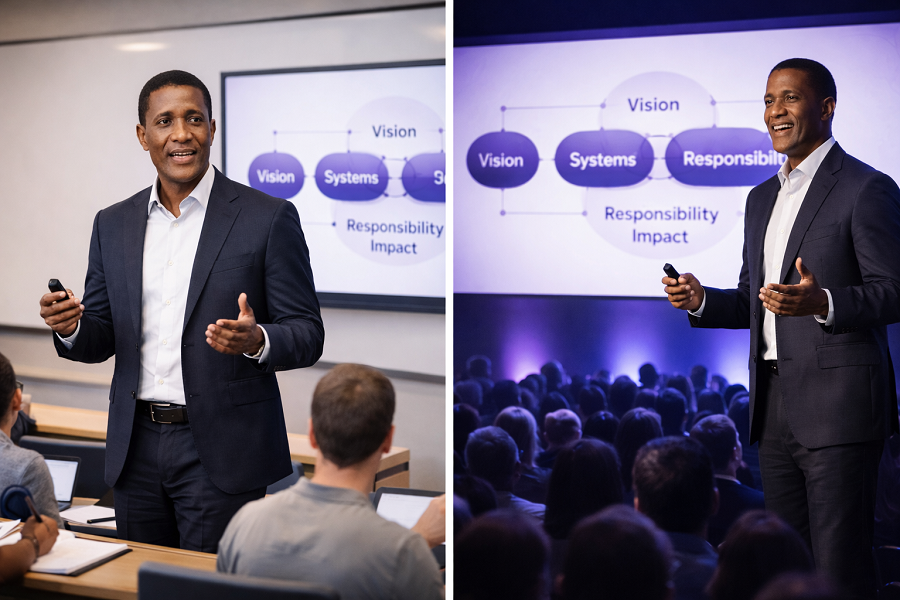
The H-TIPS framework seeks to align human capacity, time governance, innovation systems, and ethical power into one coherent architecture. It refines and unity people and structures.
Many institutions fail because they treat talent development, innovation policy, and governance ethics as separate domains. H-TIPS integrates them. It argues that leadership impact becomes sustainable only when human potential is structured, time is strategically employed, innovation is institutionalized, and power is ethically regulated.
In essence, it is a stabilization model for volatile environments and a growth model for emerging systems.